TensorSpline Foundations
Understand tensor-product spline coefficients, basis matrices, and mixed partial derivatives.
Source: Examples/Tutorials/TensorSplineFoundations.m
Build a tensor-product basis from grid vectors
The low-level multidimensional TensorSpline model is
In practice that means building one knot vector per dimension with BSpline.knotPointsForDataPoints, turning a rectilinear grid into a point matrix with pointsFromGridVectors, and then assembling the tensor basis with matrixForPointMatrix.
x = linspace(-1, 1, 7)';
y = linspace(-1.5, 1.5, 9)';
knotPoints = { ...
    BSpline.knotPointsForDataPoints(x, S=3)
    BSpline.knotPointsForDataPoints(y, S=3)};

pointMatrix = TensorSpline.pointsFromGridVectors({x, y});
values = cos(pi*pointMatrix(:,1)).*exp(-0.5*pointMatrix(:,2).^2) + 0.25*pointMatrix(:,1).*pointMatrix(:,2);
basisMatrix = TensorSpline.matrixForPointMatrix(pointMatrix, knotPoints=knotPoints, S=[3 3]);
xi = basisMatrix \ values;

tensorSpline = TensorSpline.fromKnotPoints(knotPoints, xi, S=[3 3]);
Evaluate the tensor spline and a mixed partial derivative
Tensor-product coefficients are stored in the shape implied by the basis. Evaluation still uses one query array per dimension, and mixed partials are chosen with one derivative order per dimension:
\[\frac{\partial^2 f}{\partial x \,\partial y}.\]xq = linspace(x(1), x(end), 61)';
yq = linspace(y(1), y(end), 71)';
[Xq, Yq] = ndgrid(xq, yq);
Fq = tensorSpline(Xq, Yq);
d2F = tensorSpline.valueAtPoints(Xq, Yq, D=[1 1]);
Plot the tensor-product field and the mixed partial on the same grid.
figure(Position=[100 100 920 360])
tiledlayout(1, 2, TileSpacing="compact")

nexttile
imagesc(yq, xq, Fq)
axis xy
axis tight
colorbar
xlabel("y")
ylabel("x")
title("Tensor spline value")

nexttile
imagesc(yq, xq, d2F)
axis xy
axis tight
colorbar
xlabel("y")
ylabel("x")
title("Mixed partial d^2f / dx dy")
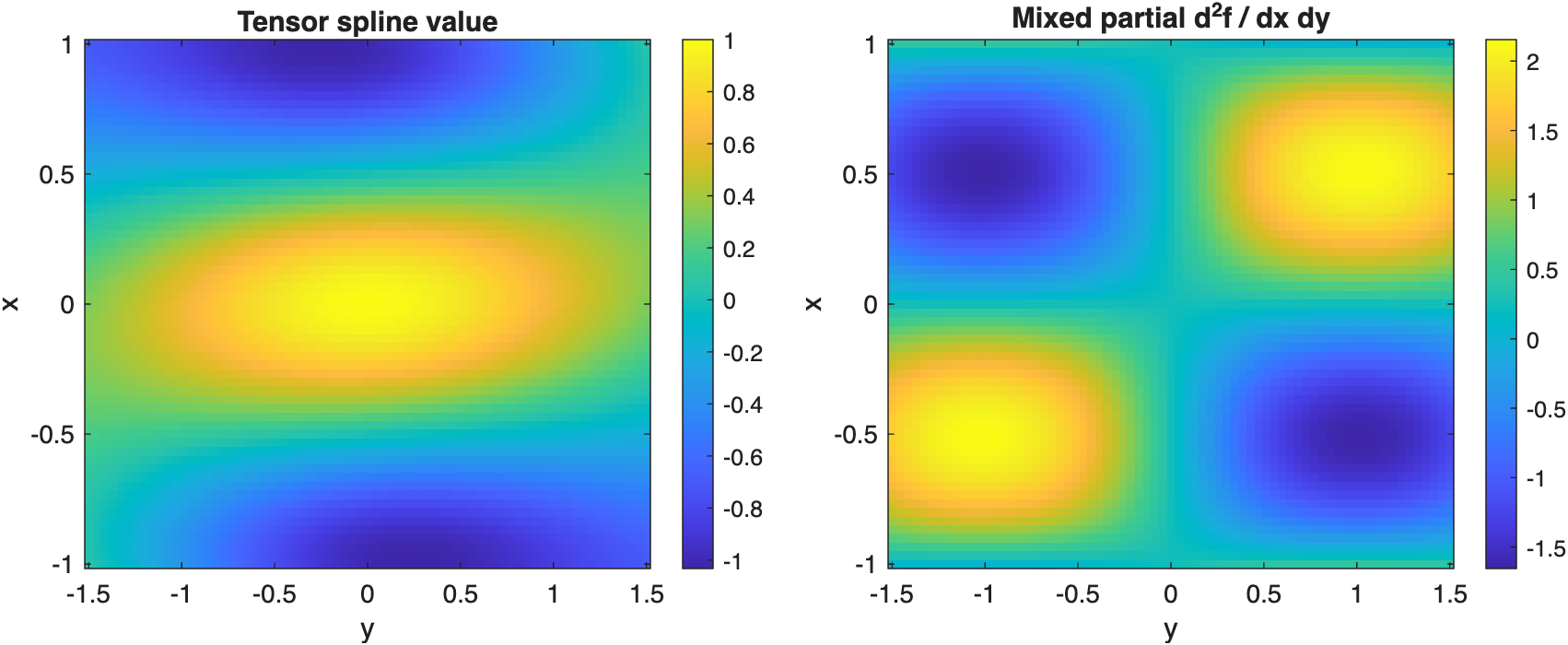
TensorSpline evaluates the tensor-product field and its mixed partial derivatives on matching query arrays.
Inspect the coefficient array shape
In two dimensions, xi is naturally stored as a matrix whose size matches basisSize. That layout is what makes the tensor-product interpretation concrete.
basisSize = tensorSpline.basisSize;
coefficientArray = tensorSpline.xi;
Plot the tensor-product coefficients in their natural two-dimensional layout.
figure(Position=[100 100 460 360])
imagesc(coefficientArray)
axis tight
colorbar
xlabel("Basis index in y")
ylabel("Basis index in x")
title("Tensor-product coefficients")
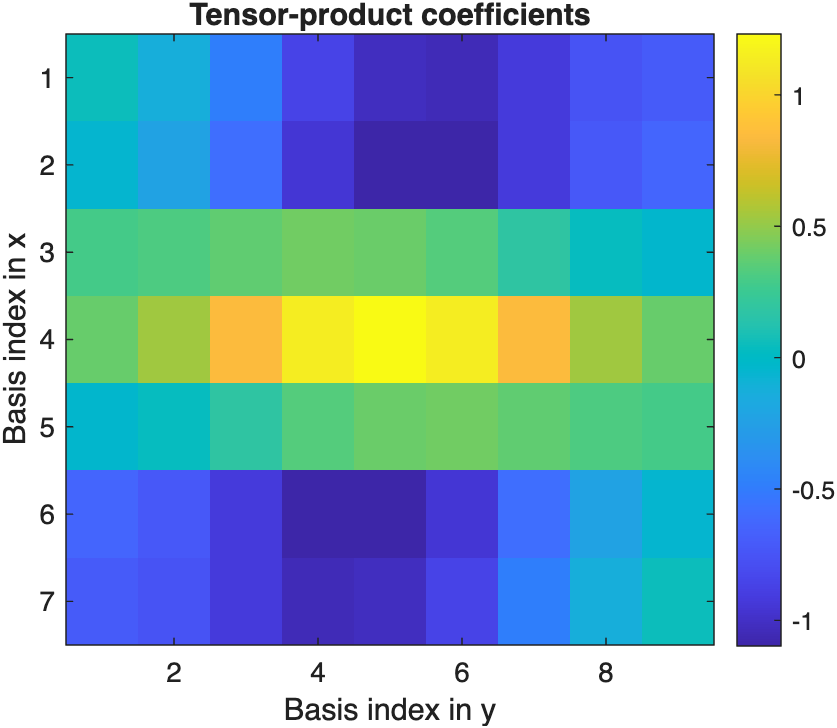
The tensor-product coefficients are stored in the same multidimensional layout as the basis itself.